


Why Some Travel Agencies Get More Bookings Than Others: The Power of Branding

Two travel agencies can sell similar destinations, hotels and holiday packages at similar prices—and still generate very different numbers of enquiries and bookings.
One agency gets messages every day.
Another keeps posting offers but receives very few serious enquiries.
The difference is often not the destination or even the price.
It is the brand.
Travel is a high-trust purchase. Customers are not simply buying a hotel room or flight ticket. They are trusting someone with their money, time, family holiday, honeymoon, business trip or once-in-a-lifetime experience.
That is why travel agency branding can have a direct influence on whether a potential customer stops scrolling, makes an enquiry, compares your offer seriously and ultimately chooses your agency.
Recent Google/Kantar research on Indian travellers found that brand trust is a leading factor in travel brand choice, while 85% of surveyed Indian travellers said they prefer to book their trips online when they have the choice.
So the question is not simply:
“How can a travel agency get more enquiries?”
A better question is:
“Why should a traveller trust and remember this agency instead of the next ten agencies offering the same package?”
That is where branding becomes powerful.
For travel businesses looking to build a stronger and more consistent brand presence, professional branding and marketing services can help bring these touchpoints together.
1. Strong travel brands look trustworthy before customers even contact them
Imagine a traveller searching Instagram for a Dubai holiday package.
They find two agencies.
Agency A has:
A professional logo
Consistent colours
High-quality destination photography
Well-designed package creatives
Clear pricing and inclusions
Consistent Instagram posts
Professional brochures
Customer reviews
A clear website
Agency B has:
Different colours on every post
Low-quality images
Crowded designs
Inconsistent logos
Unclear package information
Random promotional graphics

Even if both agencies provide the same holiday, most people will naturally feel more comfortable enquiring with Agency A.
This is the first power of branding:
Your visual identity contributes heavily to that first impression. Our guide on what customers see in the first 10 seconds explores this principle in greater detail.
Branding reduces perceived risk.
A professional visual identity does not automatically prove that a company provides better service. But it can make the business appear more established, organized and credible.
And perception matters when customers are deciding whom to trust with a significant purchase.
2. Travel customers are buying confidence, not just packages
A travel package might include:
Flights
Hotels
Transfers
Sightseeing
Visa assistance
Activities
Travel insurance
Local support
But the customer's real concern is often much simpler:
“Will everything go smoothly?”
This is particularly important when the trip involves international travel, families, elderly travellers, honeymooners or expensive itineraries.
Research into travel-agency selection has also found that consultant knowledge, experience, helpfulness and friendliness can strongly influence customer selection.
That means a travel brand should communicate more than destinations and discounts.
It should communicate:
Experience. Reliability. Transparency. Expertise. Support.
Your branding should make those qualities visible before the first conversation happens.
3. A memorable brand gets remembered when the customer is ready to travel

Travel decisions rarely happen in one second.
A person may see a Maldives reel today.
Save a Dubai package next week.
Ask a friend for recommendations later.
Search Google after a month.
Then finally contact an agency.
This is why brand recall matters.
Consistency plays a major role in creating that recall. Learn more about what makes customers remember a brand and why consistency matters.
If your agency consistently appears with the same visual identity, colours, photography style and messaging, customers have more opportunities to recognize you.
Over time:
Visibility → Recognition → Familiarity → Trust → Enquiry → Booking
This does not mean every impression produces a booking. But consistent branding helps ensure that when the customer is finally ready to purchase, your agency is easier to remember.
Google's India travel research shows that travellers use multiple touchpoints during research and planning, with Google and YouTube playing important roles throughout the journey.
Your brand therefore needs to look recognizable across those touchpoints—not just inside your office.
4. Consistency makes a small travel agency look bigger
A travel agency does not need to be a massive company to look professional.
It needs consistency.
Consider what happens when the same brand identity appears across:
Instagram
Facebook
Google Business Profile
Website
WhatsApp
Brochures
Visiting cards
Office signage
Package PDFs
Advertisements
Email communication
When the same colours, typography, logo treatment, photography style and tone are repeated, customers begin to experience one recognizable brand.
Choosing these elements strategically matters because colours and typography influence how people perceive a brand. Read more about how colours and fonts affect brand perception.
This is particularly valuable for smaller travel agencies competing against larger OTAs and established companies.
You may not be able to compete on advertising budgets.
But you can compete on clarity, personality and trust.
5. Your social media design can influence the first enquiry
For many travel agencies, Instagram is effectively a digital showroom.
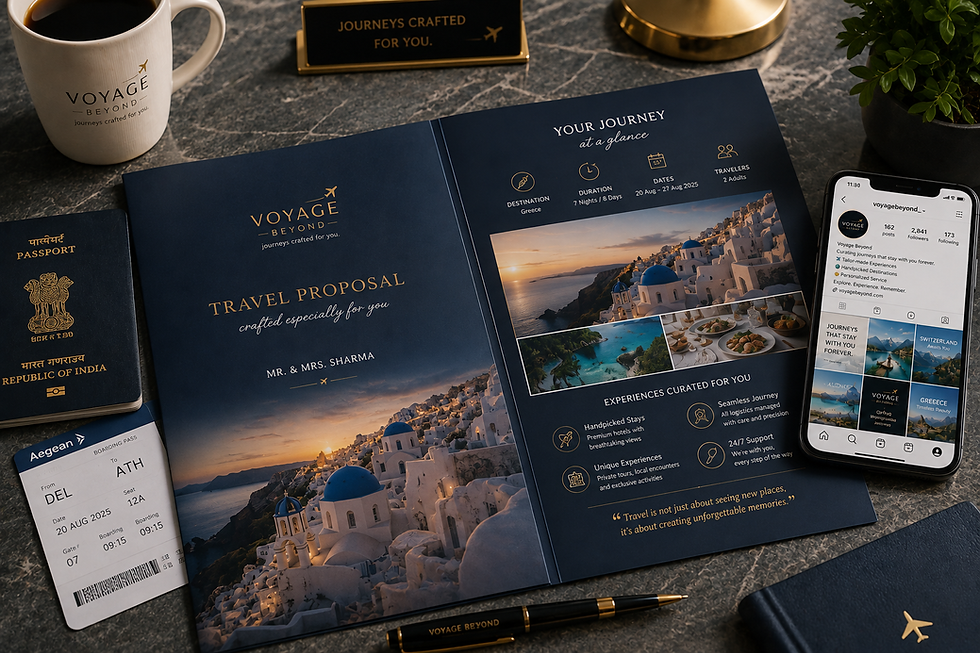
A customer may never visit your physical office before contacting you.
Their first interaction might be a reel showing Bali.
Then they see a carousel about visa assistance.
Then a testimonial.
Then a family holiday package.
Then your profile.
Every piece of content contributes to their perception of your agency.
That is why travel agency social media should not become a collection of unrelated promotional posters.
Instead, it should have a recognizable visual system.
For example:
Destination InspirationBeautiful visuals that create desire.
Travel TipsUseful content that demonstrates expertise.
Package ContentClear offers that encourage enquiries.
Customer ExperiencesSocial proof that reduces uncertainty.
Behind the ScenesHuman content that builds familiarity.
FAQsInformation that removes booking objections.
The objective is not simply to make the Instagram feed beautiful.
It is to make the brand credible, useful and memorable.
6. Branding helps agencies compete beyond price
One of the biggest problems in the travel industry is price comparison.
If your marketing communicates only:
“Dubai Package – ₹XX,XXX”
the customer may compare your price with five competitors.
The cheapest option can easily become the winner.
But a strong brand changes the conversation.
Instead of selling only a package, communicate your value:
Personalized itinerary planning
Destination expertise
Transparent inclusions
Visa guidance
Hotel recommendations
Airport transfers
On-trip assistance
Flexible options
Family-focused planning
Honeymoon specialization
Corporate travel support
Now the customer is comparing value, not just price.
Google/Kantar research across APAC found that travellers prioritize value and brand trust over simply choosing the lowest price.
That is a major opportunity for travel agencies.
7. Professional brochures and proposals can help close high-value enquiries

Not every booking happens directly through Instagram.
For larger holidays, corporate travel, destination weddings, group tours and international packages, customers may want a detailed proposal.
A professionally designed travel brochure or itinerary can make the agency feel significantly more credible.
Instead of sending a basic PDF containing hotel names and prices, create a branded experience with:
Destination overview
Day-by-day itinerary
Hotel information
Activities
Inclusions and exclusions
Important travel information
High-quality imagery
Clear pricing
Terms and conditions
Contact details
Brand identity
The proposal becomes more than information.
A professionally designed travel brochure and marketing proposal can help communicate the experience more clearly while keeping the agency's brand consistent.
It becomes a sales tool.
8. Trust signals are essential in travel branding
A beautiful logo alone will not generate bookings.
Customers need evidence that the business is trustworthy.
Important trust signals can include:
Customer reviews
Show genuine reviews prominently and consistently.
Real travel content
Use authentic destination and customer content wherever possible.
Clear contact information
Customers should easily understand how to reach you.
Transparent pricing
Avoid confusing offers and hidden costs.
Professional website
Your website should clearly explain services, destinations and enquiry options.
Consistent communication
The professionalism of your WhatsApp messages, proposals and emails should match your visual identity.
Expertise
Create content that demonstrates genuine knowledge about destinations, visas, hotels, itineraries and travel planning.
Research has repeatedly connected trust, transparency and customer experience with travel purchase decisions.
9. Your brand should have a clear reason to choose you
“Best travel agency” is not a strong positioning strategy because almost everyone can say it.
A stronger travel brand answers:
Why should I choose you?
For example, a hypothetical agency could position itself around:
Family Holidays“Stress-free international holidays for families.”
Honeymoons“Personalized romantic escapes for newlyweds.”
Corporate Travel“Reliable business travel management for growing companies.”
Luxury Travel“Curated premium experiences with personalized assistance.”
Budget Travel“Smart international holidays without unnecessary costs.”
The objective is not to serve everyone with the same message.
It is to make the right customer feel:
“This agency understands exactly what I need.”
10. Branding must continue after the customer books
A common mistake is treating branding as something that happens before the sale.
In travel, the customer experience itself becomes part of the brand.
Think about the journey:
Instagram → Enquiry → WhatsApp → Proposal → Payment → Pre-trip Support → Travel → Post-trip Follow-up
Every step communicates something.
If the Instagram looks premium but the proposal looks unprofessional, trust drops.
If the sales conversation is excellent but post-booking communication is poor, the experience becomes inconsistent.
Strong travel brands create consistency across the entire customer journey.
11. What should a travel agency invest in first?
If your agency is currently relying heavily on price-based promotions, start by building the foundation.
Step 1: Define your positioning
Decide what type of traveller you want to attract and what makes your agency different.
Step 2: Build a professional visual identity
Create a consistent system for:
Logo
Colours
Typography
Photography
Icons
Social media templates
Marketing materials
Step 3: Upgrade your digital presence
Your website and social media should communicate the same brand.
Step 4: Create content around customer questions
Instead of posting offers every day, answer questions such as:
How much does a Dubai trip cost?
Which Bali hotels are best for families?
What documents are needed for a visa?
What is included in a Europe tour?
When is the best time to visit Singapore?
Useful content builds authority.
Step 5: Build social proof
Collect genuine customer reviews, testimonials and travel experiences.
Step 6: Improve your enquiry process
Make it easy for people to ask for a quote.
Step 7: Keep the brand consistent
Consistency is not about making every post identical.
It is about making every touchpoint feel like it belongs to the same company.
12. The real advantage of travel agency branding
The strongest travel agencies are not necessarily the ones shouting the loudest about discounts.
They are the ones that make customers feel confident.
A traveller should be able to encounter your brand multiple times and gradually understand:
Who you are What you specialize in.Why they should trust you.What experience they can expect. How to contact you.
That is the real power of branding.
Technology is also changing travel discovery. Expedia Group's 2026 research found that travellers are increasingly using AI for planning and discovery, but 68% still preferred booking with a trusted travel brand over AI platforms.
The lesson is important:
Technology may change how people discover travel, but trust still matters when people decide where to book.
Branding can turn a travel agency into a travel brand
There is a difference between a business that sells holidays and a brand that people remember when they want to travel.
A travel business says:
“We have packages.”
A travel brand says:
“We know what you need, we understand your journey, and you can trust us to handle it.”
That distinction can influence everything from the first Instagram impression to the final booking decision.
For travel agencies, branding is therefore not simply about designing a beautiful logo.
It is about creating a recognizable identity, communicating value, building trust, demonstrating expertise and delivering a consistent customer experience.
And when customers trust your brand, you have a better chance of competing on value rather than price alone.
Frequently Asked Questions
1. Why is branding important for a travel agency?
Branding helps a travel agency become recognizable, credible and memorable. A strong brand can reduce perceived risk, communicate expertise and help customers differentiate one agency from another.
2. Does a better logo really increase travel bookings?
A logo alone does not create bookings. However, a professional logo combined with clear positioning, consistent visual identity, strong communication and a reliable customer experience can strengthen the overall perception of a travel agency.
3. How can a travel agency build customer trust?
Travel agencies can build trust through genuine reviews, transparent pricing, professional communication, useful travel content, clear policies, strong customer support and consistent branding.
4. Should travel agencies focus on social media branding?
Yes. Social media is an important discovery and research channel for travellers. A consistent feed can help establish recognition, communicate expertise and create confidence before a customer makes an enquiry.
5. Is branding more important than offering cheap travel packages?
Not necessarily one or the other. Competitive pricing matters, but strong branding can help agencies communicate value beyond price. This makes it easier to compete on service, expertise, convenience and experience rather than discounting alone.
6. What should a travel agency include in its brand identity?
A travel agency's identity can include its logo, colour palette, typography, photography style, graphic elements, messaging style, social media templates, brochures, presentations, website design and other customer-facing materials.
7. Can branding help a small travel agency compete with large travel companies?
Yes. Smaller agencies can differentiate through specialization, personalized service, local expertise, distinctive positioning and a consistent brand experience rather than trying to compete only through advertising budgets.
8. How often should a travel agency update its branding?
There is no universal timeline. A brand should be reviewed when its positioning changes, the target audience evolves, the visual identity becomes outdated or the business has grown beyond its original identity. Avoid changing the brand simply because a new design trend appears.
Conclusion
More bookings do not always go to the travel agency with the cheapest package.
They often go to the agency that makes the customer feel most confident about booking.
That confidence is built through many small signals: professional design, consistent communication, useful content, genuine reviews, clear pricing, destination expertise and reliable service.
That is why travel agency branding deserves to be treated as a business investment—not just a design exercise.
If your travel agency has good services but your brand does not communicate their value, it may be time to rethink how customers experience your business.
Build a travel brand people remember.
Orange Circle helps businesses develop strategic brand identities, marketing creatives, brochures, social media designs and other brand touchpoints that create a consistent professional presence. For travel businesses looking to strengthen their visual identity and marketing communication, you can explore Orange Circle's branding services or contact the team for a consultation.


Comments